> ## Documentation Index
> Fetch the complete documentation index at: https://docs.bindbee.dev/llms.txt
> Use this file to discover all available pages before exploring further.
# Relink a Connector
> Re-authorize a connector whose credentials stopped working.
Source-system credentials expire, get rotated, or lose access. The connector moves to `RELINK_NEEDED` and stops syncing.
Reads keep returning the last successful sync, so downstream systems treat stale data as current. The data endpoints answer `200` throughout.
Relink the existing connector. Deleting it and starting fresh breaks every Bindbee ID you
have stored - see [Relinking versus deleting](#relinking-versus-deleting).
**Before you start**
* You've confirmed the failure is credential-related, rather than a permission gap - see [Origin-system errors](/guides/troubleshooting/errors#origin-system-errors).
* You can reach the customer's HRIS administrator.
## Steps
Locate it under **Connectors**. The **Relink Needed** counter above the list totals every connection in this state.
**Result:** You can see its current status and sync history.
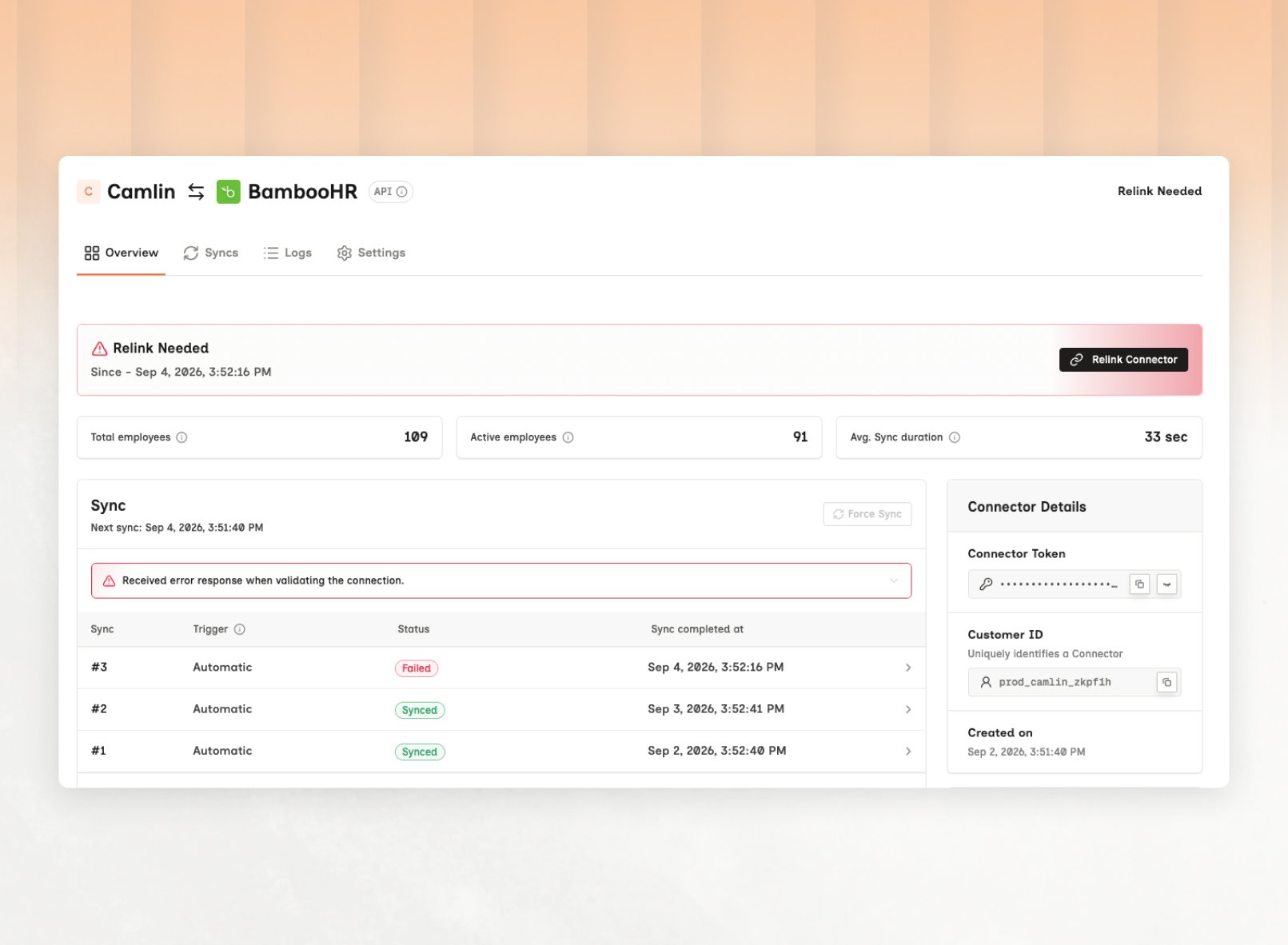
A connector needing re-authorization carries a **Relink Needed** banner with the date it entered that state, and **Force Sync** is disabled. Click **Relink Connector** to produce an updated Magic Link for the same connector.
**Result:** A link ready to send to the customer.
 Forward the link to whoever administers their HRIS, with the relevant guide from [help.bindbee.dev](https://help.bindbee.dev).
Where a token, certificate, or integration user was rotated on their side, they need the new values ready before opening the link.
**Result:** The customer has what they need to reconnect.
Once they've reconnected, trigger a sync rather than waiting for the next scheduled run. Then check the run completed in the connector's sync history.
**Result:** The connector is syncing again and the data is current.
The `connector_token` survives a relink. Relinking updates the credentials behind the
connector rather than the connector itself.
## Relinking versus deleting
A connector in `RELINK_NEEDED` has two exits.
```mermaid theme={null}
stateDiagram-v2
COMPLETE --> RELINK_NEEDED: credentials stop working
RELINK_NEEDED --> COMPLETE: customer relinks
RELINK_NEEDED --> [*]: delete
```
**Relinking** keeps the connector's identity, history, records and `connector_token`, and syncing resumes where it left off. This is the right response to a broken connector.
**Deleting** removes the connector *and its data* - identifiers, records, sync history. Recovery means a new connector and a fresh initial sync. Every record comes back with a new Bindbee `id`, breaking any foreign key you stored.
Deletion earns its place when a customer churns or a connection was created in error - see [Data deletion](/guides/workspace/data-deletion).
## Catch it earlier
The expensive part is the days before anyone notices. Subscribe to `connector_sync_error` and a stalled connector reaches you the day it breaks - see [Monitoring this programmatically](/guides/troubleshooting/sync-status#monitoring-this-programmatically).
Branch on `connector.connector_status` in the payload. `RELINK_NEEDED` is the one value that means your customer must act. The rest retry on the next scheduled sync.
A connector can sit at `COMPLETE` with its last sync `Failed`. Credentials are fine and data
still isn't arriving, which is a different problem - see [Sync status](/guides/troubleshooting/sync-status).
## Frequently Asked Questions
The credentials are valid and lack the access the sync needs - see [Origin-system errors](/guides/troubleshooting/errors#origin-system-errors).
Mark the connection degraded in your own system so downstream jobs skip it rather than consuming stale data. The connector keeps its last synced state.
Recurring expiry points at a personal account subject to password rotation or offboarding, where a dedicated integration user belongs. A service account fixes it permanently.
## Related
* [Sync status](/guides/troubleshooting/sync-status) - the first check, and where sync alerting is set up
* [Errors](/guides/troubleshooting/errors) - when credentials work and a model still fails
* [How connections work](/get-started/how-to-connect) - how a connector is created
* [Record identity](/guides/reading-writing/record-identity) - why a delete-and-recreate changes every stored `id`
Forward the link to whoever administers their HRIS, with the relevant guide from [help.bindbee.dev](https://help.bindbee.dev).
Where a token, certificate, or integration user was rotated on their side, they need the new values ready before opening the link.
**Result:** The customer has what they need to reconnect.
Once they've reconnected, trigger a sync rather than waiting for the next scheduled run. Then check the run completed in the connector's sync history.
**Result:** The connector is syncing again and the data is current.
The `connector_token` survives a relink. Relinking updates the credentials behind the
connector rather than the connector itself.
## Relinking versus deleting
A connector in `RELINK_NEEDED` has two exits.
```mermaid theme={null}
stateDiagram-v2
COMPLETE --> RELINK_NEEDED: credentials stop working
RELINK_NEEDED --> COMPLETE: customer relinks
RELINK_NEEDED --> [*]: delete
```
**Relinking** keeps the connector's identity, history, records and `connector_token`, and syncing resumes where it left off. This is the right response to a broken connector.
**Deleting** removes the connector *and its data* - identifiers, records, sync history. Recovery means a new connector and a fresh initial sync. Every record comes back with a new Bindbee `id`, breaking any foreign key you stored.
Deletion earns its place when a customer churns or a connection was created in error - see [Data deletion](/guides/workspace/data-deletion).
## Catch it earlier
The expensive part is the days before anyone notices. Subscribe to `connector_sync_error` and a stalled connector reaches you the day it breaks - see [Monitoring this programmatically](/guides/troubleshooting/sync-status#monitoring-this-programmatically).
Branch on `connector.connector_status` in the payload. `RELINK_NEEDED` is the one value that means your customer must act. The rest retry on the next scheduled sync.
A connector can sit at `COMPLETE` with its last sync `Failed`. Credentials are fine and data
still isn't arriving, which is a different problem - see [Sync status](/guides/troubleshooting/sync-status).
## Frequently Asked Questions
The credentials are valid and lack the access the sync needs - see [Origin-system errors](/guides/troubleshooting/errors#origin-system-errors).
Mark the connection degraded in your own system so downstream jobs skip it rather than consuming stale data. The connector keeps its last synced state.
Recurring expiry points at a personal account subject to password rotation or offboarding, where a dedicated integration user belongs. A service account fixes it permanently.
## Related
* [Sync status](/guides/troubleshooting/sync-status) - the first check, and where sync alerting is set up
* [Errors](/guides/troubleshooting/errors) - when credentials work and a model still fails
* [How connections work](/get-started/how-to-connect) - how a connector is created
* [Record identity](/guides/reading-writing/record-identity) - why a delete-and-recreate changes every stored `id`